Response Surface Model Example
Data Source
A Central Composite Design with two responses
This example uses experimental data published in Czitrom and Spagon, (1997), Statistical Case Studies for Industrial Process Improvement. The material is copyrighted by the American Statistical Association and the Society for Industrial and Applied Mathematics, and is used with their permission. Specifically, Chapter 15, titled "Elimination of TiN Peeling During Exposure to CVD Tungsten Deposition Process Using Designed Experiments", describes a semiconductor wafer processing experiment (labeled Experiment 2).
Goal, response variables, and factor variables
The goal of this experiment was to fit response surface models to the two responses, deposition layer Uniformity and deposition layer Stress, as a function of two particular controllable factors of the chemical vapor deposition (CVD) reactor process. These factors were Pressure (measured in torr) and the ratio of the gaseous reactants H₂ and WF₆ (called H₂/WF₆). The experiment also included an important third (categorical) response — the presence or absence of titanium nitride (TiN) peeling. The third response has been omitted in this example in order to focus on the response surface aspects of the experiment.
To summarize, the goal is to obtain a response surface model for two responses, Uniformity and Stress. The factors are: Pressure and H₂/WF₆.
Experiment Description
The design is a 13-run Central Composite Inscribed (CCI) design with 3 centerpoints
The minimum and maximum values chosen for Pressure were 4 torr and 80 torr. The minimum and maximum H₂/WF₆ ratios were chosen to be 2 and 10. Since response curvature, especially for Uniformity, was a distinct possibility, an experimental design that allowed estimating a second order (quadratic) model was needed. The experimenters decided to use a central composite inscribed (CCI) design. For two factors, this design is typically recommended to have 13 runs with 5 centerpoint runs. However, the experimenters, perhaps to conserve a limited supply of wafer resources, chose to include only 3 centerpoint runs. The design is still rotatable, but the uniform precision property has been sacrificed.
Table containing the CCI design points and experimental responses
The table below shows the CCI design and experimental responses, in the order in which they were run (presumably randomized). The last two columns show coded values of the factors.
| Run | Pressure | H₂/WF₆ | Uniformity | Stress | Coded Pressure | Coded H₂/WF₆ |
|---|---|---|---|---|---|---|
| 1 | 80 | 6 | 4.6 | 8.04 | 1 | 0 |
| 2 | 42 | 6 | 6.2 | 7.78 | 0 | 0 |
| 3 | 68.87 | 3.17 | 3.4 | 7.58 | 0.71 | -0.71 |
| 4 | 15.13 | 8.83 | 6.9 | 7.27 | -0.71 | 0.71 |
| 5 | 4 | 6 | 7.3 | 6.49 | -1 | 0 |
| 6 | 42 | 6 | 6.4 | 7.69 | 0 | 0 |
| 7 | 15.13 | 3.17 | 8.6 | 6.66 | -0.71 | -0.71 |
| 8 | 42 | 2 | 6.3 | 7.16 | 0 | -1 |
| 9 | 68.87 | 8.83 | 5.1 | 8.33 | 0.71 | 0.71 |
| 10 | 42 | 10 | 5.4 | 8.19 | 0 | 1 |
| 11 | 42 | 6 | 5.0 | 7.90 | 0 | 0 |
Low values of both responses are better than high
Uniformity is calculated from four-point probe sheet resistance measurements made at 49 different locations across a wafer. The value in the table is the standard deviation of the 49 measurements divided by their mean, expressed as a percentage. So a smaller value of Uniformity indicates a more uniform layer — hence, lower values are desirable. The Stress calculation is based on an optical measurement of wafer bow, and again lower values are more desirable.
Analysis of DOE Data
Steps for fitting a response surface model
The steps for fitting a response surface (second-order or quadratic) model are as follows:
- Fit the full model to the first response.
- Use stepwise regression, forward selection, or backward elimination to identify important variables.
- When selecting variables for inclusion in the model, follow the hierarchy principle and keep all main effects that are part of significant higher-order terms or interactions, even if the main effect p-value is larger than you would like (note that not all analysts agree with this principle).
- Generate diagnostic residual plots (histograms, box plots, normal plots, etc.) for the model selected.
- Examine the fitted model plot, interaction plots, and ANOVA statistics (\(R^2\), adjusted \(R^2\), lack-of-fit test, etc.). Use all these plots and statistics to determine whether the model fit is satisfactory.
- Use contour plots of the response surface to explore the effect of changing factor levels on the response.
- Repeat all the above steps for the second response variable.
- After satisfactory models have been fit to both responses, you can overlay the surface contours for both responses.
- Find optimal factor settings.
Fitting a Model to the Uniformity Response, Simplifying the Model and Checking Residuals
Fit full quadratic model to Uniformity response
Source              Estimate  Std. Error  t value  Pr(>|t|)
------              --------  ----------  -------  --------
Intercept            5.86613     0.41773   14.043  3.29e-05
Pressure            -1.90967     0.36103   -5.289  0.00322
H2/WF6              -0.22408     0.36103   -0.621  0.56201
Pressure*H2/WF6      1.68617     0.71766    2.350  0.06560
Pressure^2           0.13373     0.60733    0.220  0.83442
H2/WF6^2             0.03373     0.60733    0.056  0.95786

Residual standard error:  0.7235 based on 5 degrees of freedom
Multiple R-squared:  0.8716
Adjusted R-squared:  0.7431
F-statistic:  6.787 based on 5 and 5 degrees of freedom
p-value:  0.0278
Stepwise regression for Uniformity
Start:   AIC=-3.79
Model:   Uniformity ~ Pressure + H2/WF6 + Pressure*H2/WF6 + Pressure^2 + H2/WF6^2

Step 1:  Remove H2/WF6^2, AIC=-5.79
Model:   Uniformity ~ Pressure + H2/WF6 + Pressure*H2/WF6 + Pressure^2

Step 2:  Remove Pressure^2,  AIC=-7.69
Model:   Uniformity ~ Pressure + H2/WF6 + Pressure*H2/WF6

Step 3:  Remove H2/WF6,  AIC=-8.88
Model:   Uniformity ~ Pressure + Pressure*H2/WF6
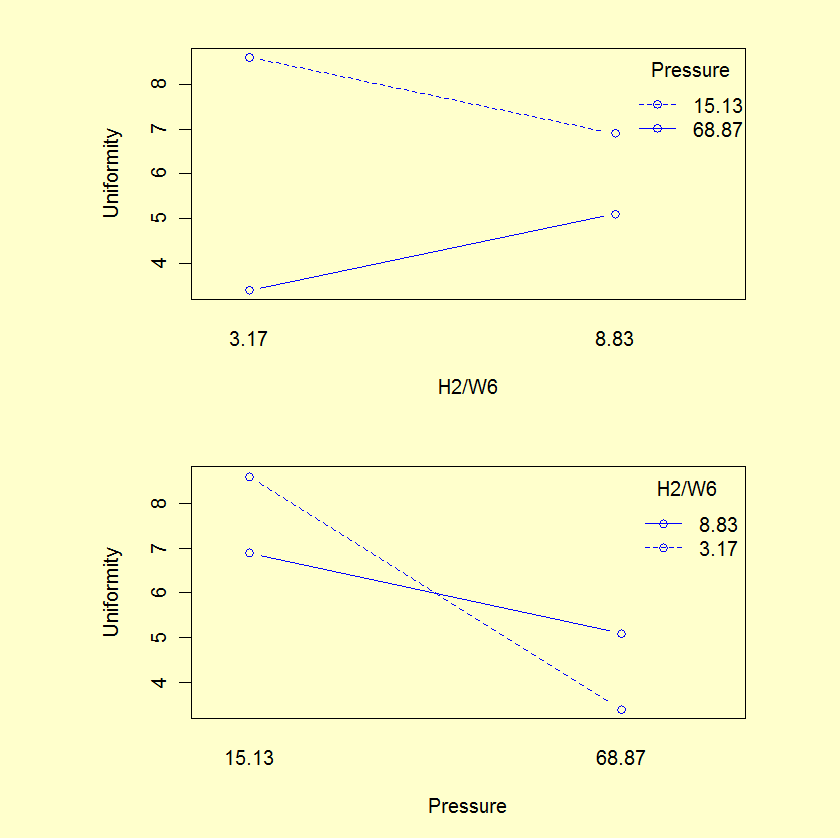
The stepwise routine selects a model containing the intercept, Pressure, and the interaction term. However, many statisticians do not think an interaction term should be included in a model unless both main effects are also included. Thus, we will use the model from Step 2 that included Pressure, H₂/WF₆, and the interaction term. Interaction plots confirm the need for an interaction term in the model.
Analysis of model selected by stepwise regression for Uniformity
Source           DF Sum of Sq  Mean Sq   F value   Pr(>F)
------           -- ---------  -------   -------   ------
Model             3   17.739   5.9130      15.66   0.0017
Total error       7    2.643   0.3776

Lack-of-fit       5   1.4963   0.2993       0.52   0.7588
Pure error        2   1.1467   0.5734


Source           Estimate  Std. Error  t value  Pr(>|t|)
------           --------  ----------  -------  --------
Intercept          5.9273     0.1853    31.993  7.54e-09
Pressure          -1.9097     0.3066    -6.228  0.000433
H2/WF6            -0.2241     0.3066    -0.731  0.488607
Pressure*H2/WF6    1.6862     0.6095     2.767  0.027829

Residual standard error:  0.6145 based on 7 degrees of freedom
Multiple R-squared:  0.8703
Adjusted R-squared:  0.8148
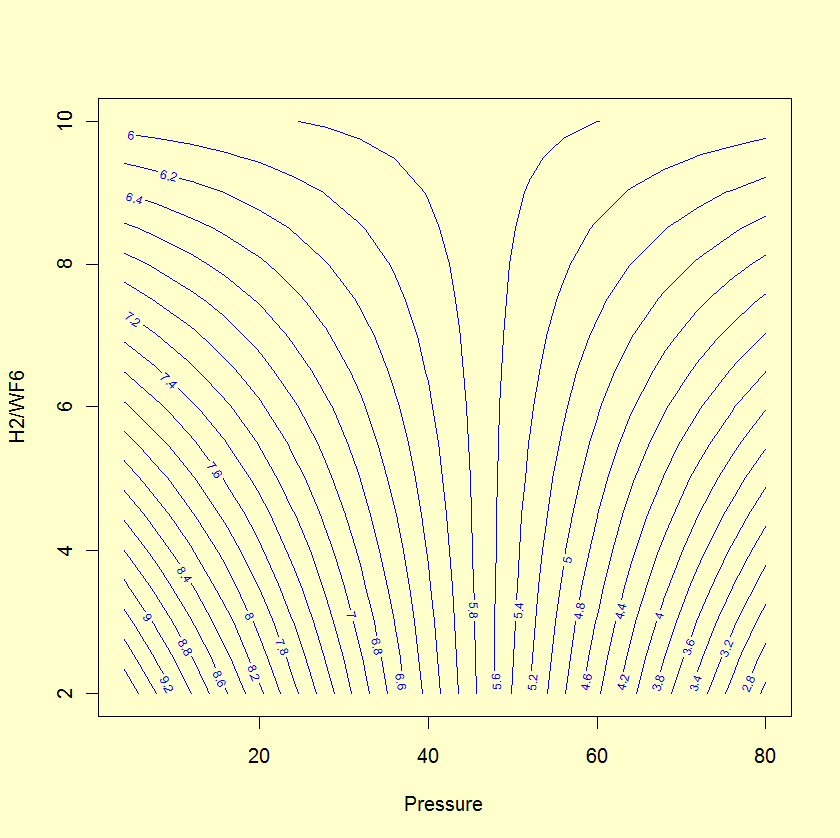
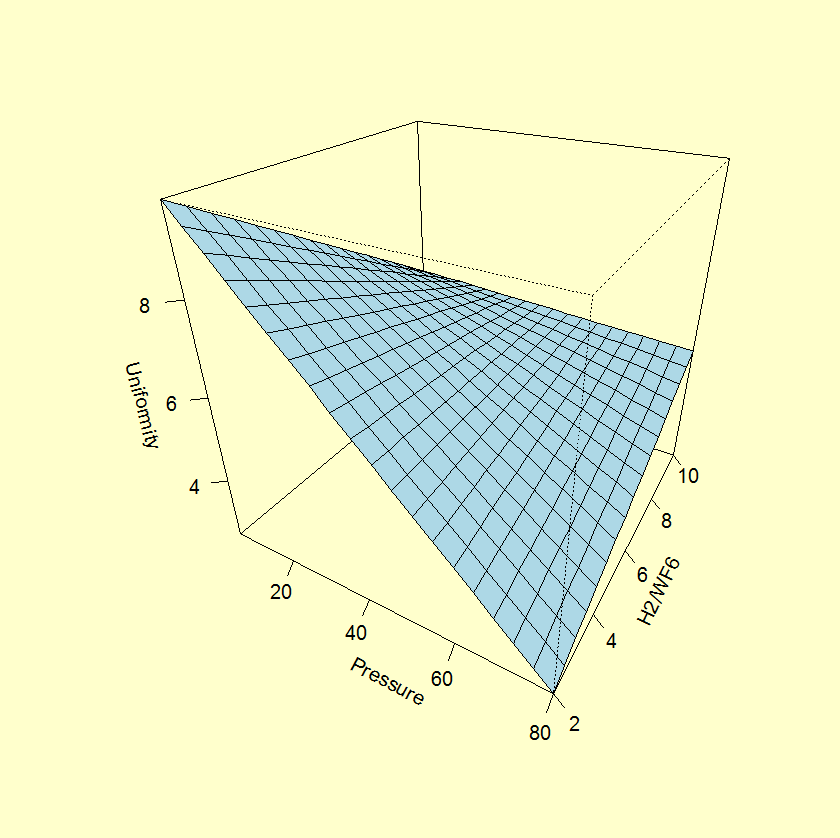
A contour plot and perspective plot of Uniformity provide a visual display of the response surface.
Residual plots
We perform a residuals analysis to validate the model assumptions. We generate a normal plot, a box plot, a histogram and a run-order plot of the residuals.
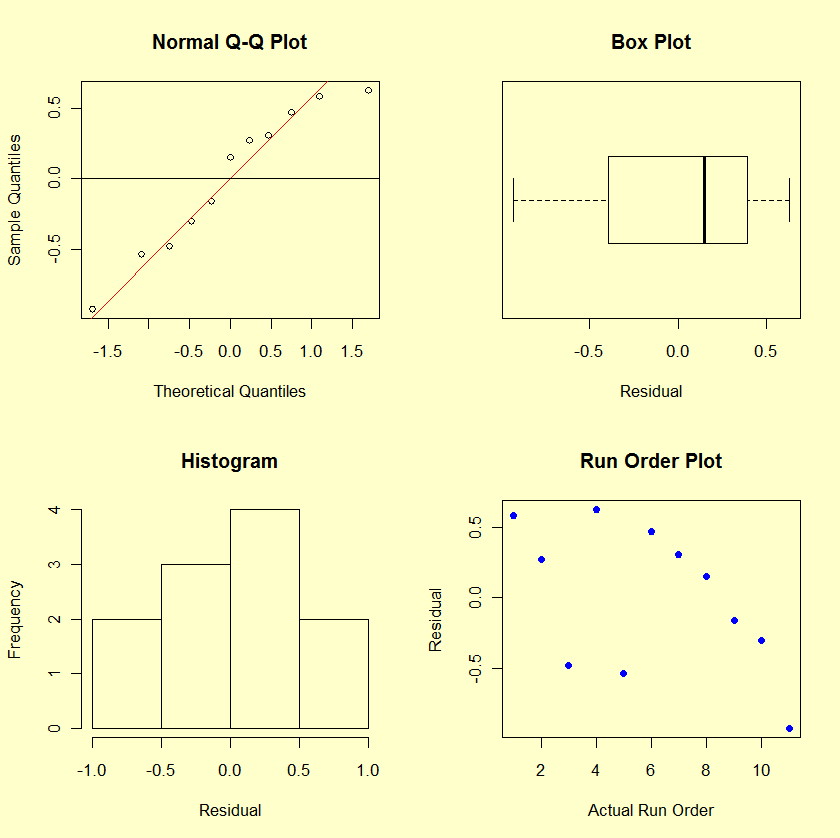
The residual plots do not indicate problems with the underlying assumptions.
Conclusions from the analysis
From the above output, we make the following conclusions.
- The \(R^2\) is reasonable for fitting Uniformity (well known to be a difficult response to model).
- The lack-of-fit test is not significant (very small "Prob > F" would indicate a lack of fit).
- The residual plots do not reveal any major violations of the underlying assumptions.
- The interaction plot shows why an interaction term is needed (parallel lines would suggest no interaction).
Fitting a Model to the Stress Response, Simplifying the Model and Checking Residuals
Fit full quadratic model to Stress response
Source            Estimate  Std. Error  t value  Pr(>|t|)
------            --------   ---------  -------  --------
Intercept         8.056791    0.179561   44.869  1.04e-07
Pressure          0.735933    0.038524   19.103  7.25e-06
H2/WF6            0.852099    0.198192    4.299   0.00772
Pressure*H2/WF6   0.069431    0.076578    0.907   0.40616
Pressure^2       -0.528848    0.064839   -8.156   0.00045
H2/WF6^2         -0.007414    0.004057   -1.827   0.12722

Residual standard error:  0.07721 based on 5 degrees of freedom
Multiple R-squared:  0.9917
Adjusted R-squared:  0.9834
F-statistic:  119.8 based on 5 and 5 degrees of freedom
p-value:  3.358e-05
Stepwise regression for Stress
Start:   AIC=-53.02
Model:   Stress ~ Pressure + H2/WF6 + Pressure*H2/WF6 + Pressure^2 + H2/WF6^2

Step 1:  AIC=-53.35
Model:   Stress ~ Pressure + H2/WF6 + Pressure^2 + H2/WF6^2
The stepwise routine identifies a model containing the intercept, the main effects, and both squared terms. However, the fit of the full quadratic model indicates that neither the H₂/WF₆ squared term nor the interaction term are significant. A comparison of the full model and the model containing just the main effects and squared pressure terms indicates that there is no significant difference between the two models.
Model 1: Stress ~ Pressure + H2/WF6 + Pressure^2
Model 2: Stress ~ Pressure + H2/WF6 + Pressure^2 + Pressure*H2/WF6 + H2/WF6^2

Source      DF Sum of Sq  Mean Sq   F value    Pr(>F)
------      -- ---------  -------   -------   -------
Model 1      2  0.024802  0.01240      2.08      0.22
Model 2      5  0.029804  0.00596
In addition, interaction plots do not indicate any significant interaction.
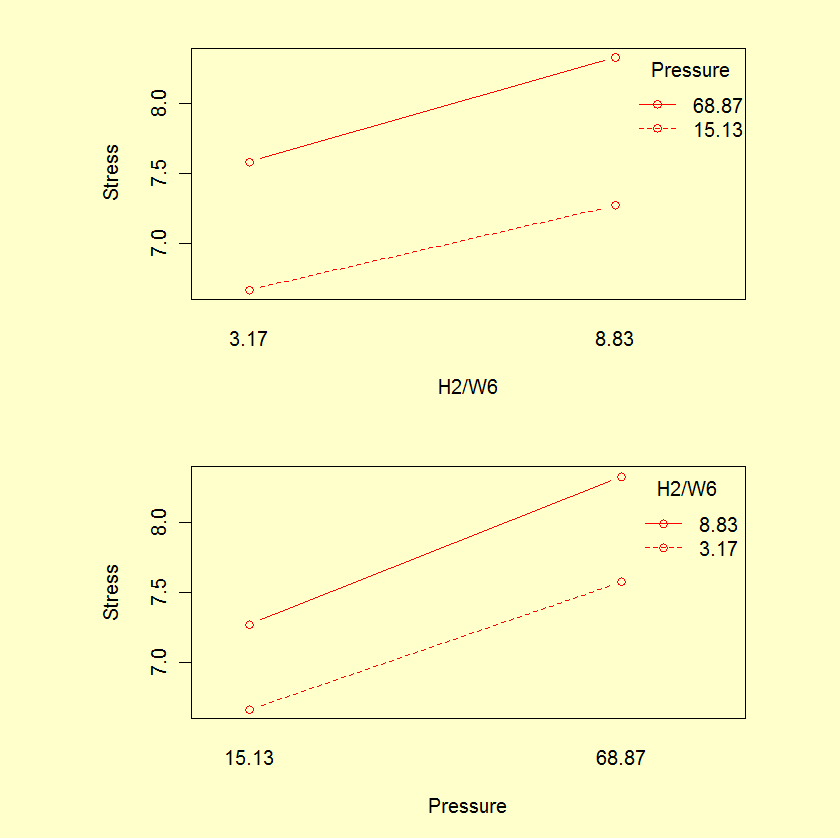
Thus, we will proceed with the model containing main effects and the squared pressure term.
The fact that the stepwise procedure selected a model for Stress containing a term that was not significant indicates that all output generated by statistical software should be carefully examined. In this case, the stepwise procedure identified the model with the lowest AIC (Akaike information criterion), but did not take into account contributions by individual terms. Other software using a different criteria may identify a different model, so it is important to understand the algorithms being used.
Analysis of reduced model for Stress
Source           DF Sum of Sq  Mean Sq   F value    Pr(>F)
------           -- ---------  -------   -------   -------
Model             3    3.5454   1.1818     151.5   9.9e-07
Total error       7    0.0546   0.0078

Lack-of-fit       5  0.032405  0.00065      0.58      0.73
Pure error        2  0.022200  0.01110

Residual standard error:  0.0883 based on 7 degrees of freedom
Multiple R-squared:  0.9848
Adjusted R-squared:  0.9783


Source        Estimate  Std. Error  t value  Pr(>|t|)
------        --------  ----------  -------  --------
Intercept      7.73410    0.03715   208.185  1.56e-14
Pressure       0.73593    0.04407    16.699  6.75e-07
H2/WF6         0.49686    0.04407    11.274  9.65e-06
Pressure^2    -0.49426    0.07094    -6.967  0.000218
A contour plot and perspective plot of Stress provide a visual representation of the response surface.
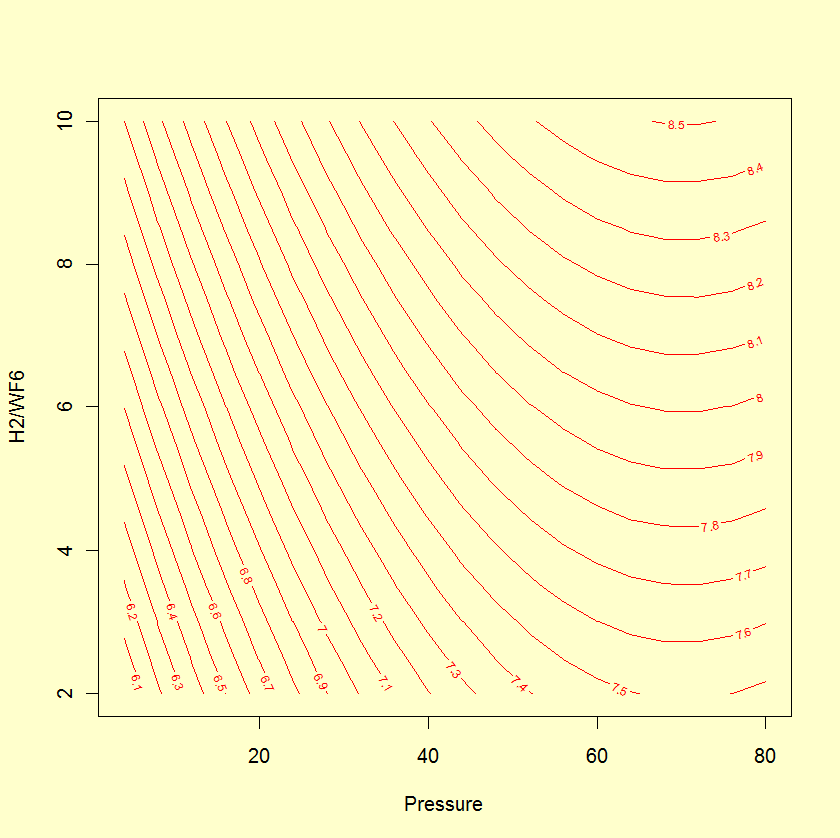
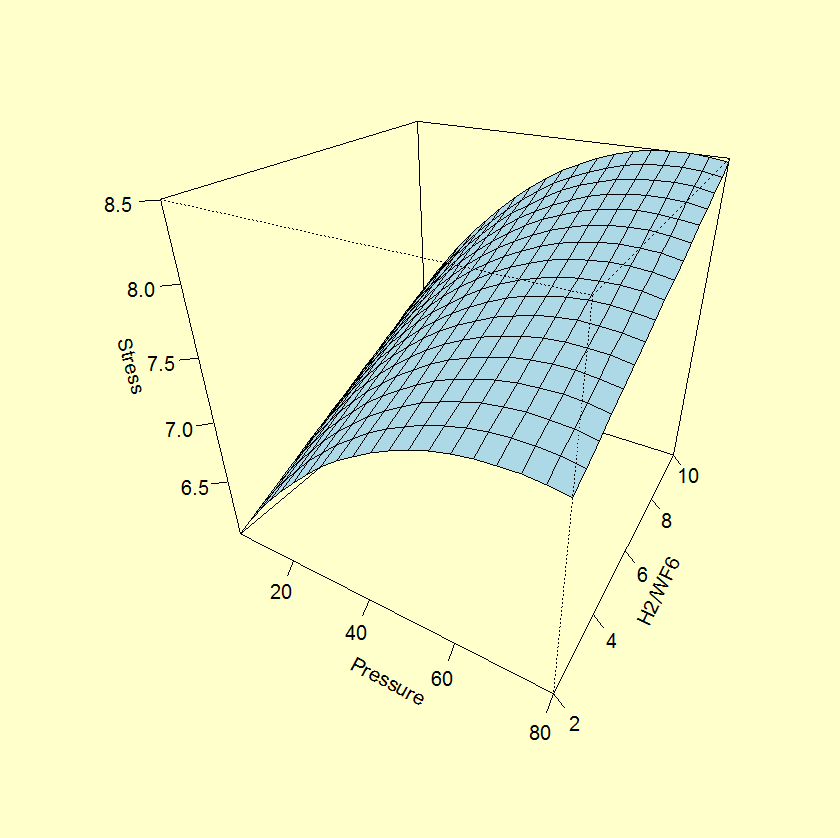
Residual plots
We perform a residuals analysis to validate the model by generating a run-order plot, box plot, histogram, and normal probability plot of the residuals.
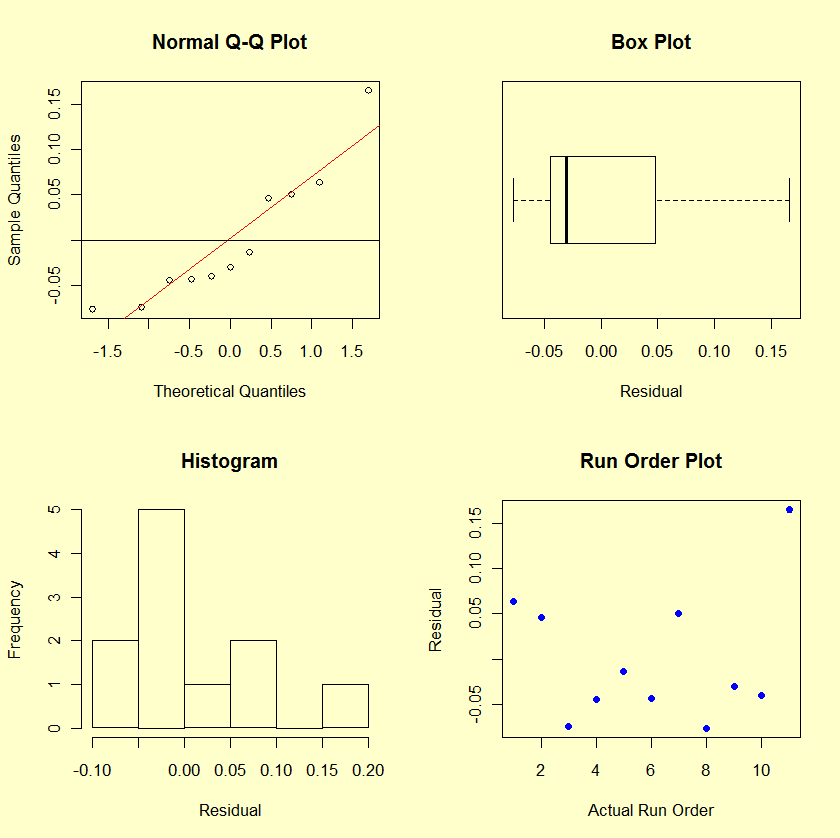
The residual plots do not indicate any major violations of the underlying assumptions.
Conclusions
From the above output, we make the following conclusions.
- The \(R^2\) is very good for fitting Stress.
- The lack-of-fit test is not significant (very small "Prob > F" would indicate a lack of fit).
- The residual plots do not reveal any major violations of the underlying assumptions.
- The nearly parallel lines in the interaction plots show why an interaction term is not needed.
Response Surface Contours for Both Responses
Overlay contour plots
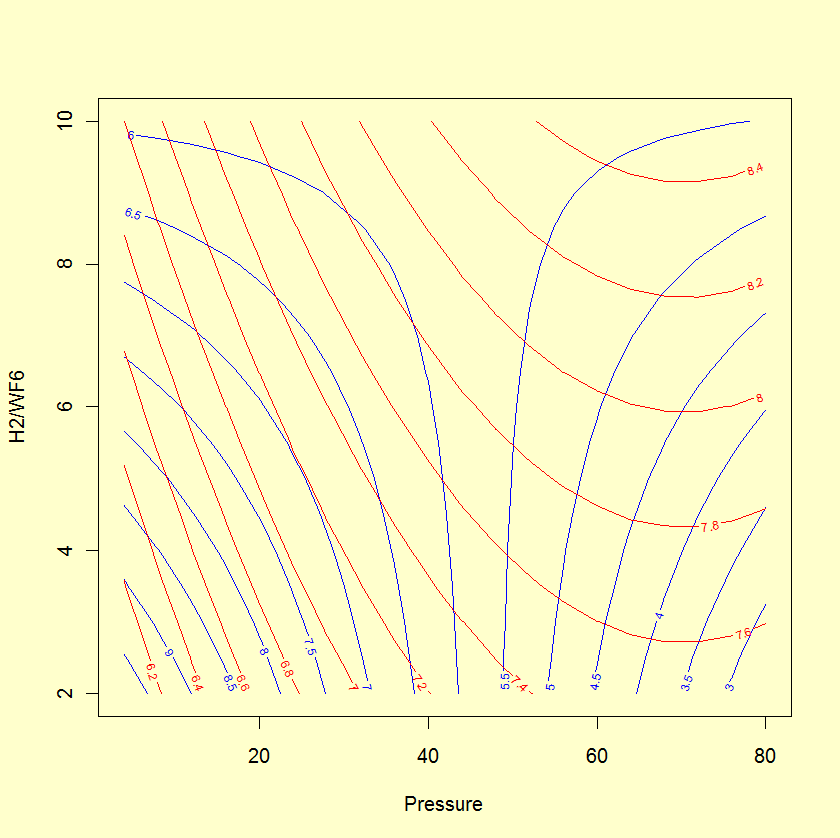
We overlay the contour plots for the two responses to visually compare the surfaces over the region of interest.
Summary
Final response surface models
The response surface models fit to (coded) Uniformity and Stress were:
Trade-offs are often needed for multiple responses
The models and the corresponding contour plots show that trade-offs have to be made when trying to achieve low values for both Uniformity and Stress since a high value of Pressure is good for Uniformity while a low value of Pressure is good for Stress. While low values of H₂/WF₆ are good for both responses, the situation is further complicated by the fact that the Peeling response (not considered in this analysis) was unacceptable for values of H₂/WF₆ below approximately 5.
Uniformity was chosen as more important
In this case, the experimenters chose to focus on optimizing Uniformity while keeping H₂/WF₆ at 5. That meant setting Pressure at 80 torr.
Confirmation runs validated the model projections
A set of 16 verification runs at the chosen conditions confirmed that all goals, except those for the Stress response, were met by this set of process settings.